
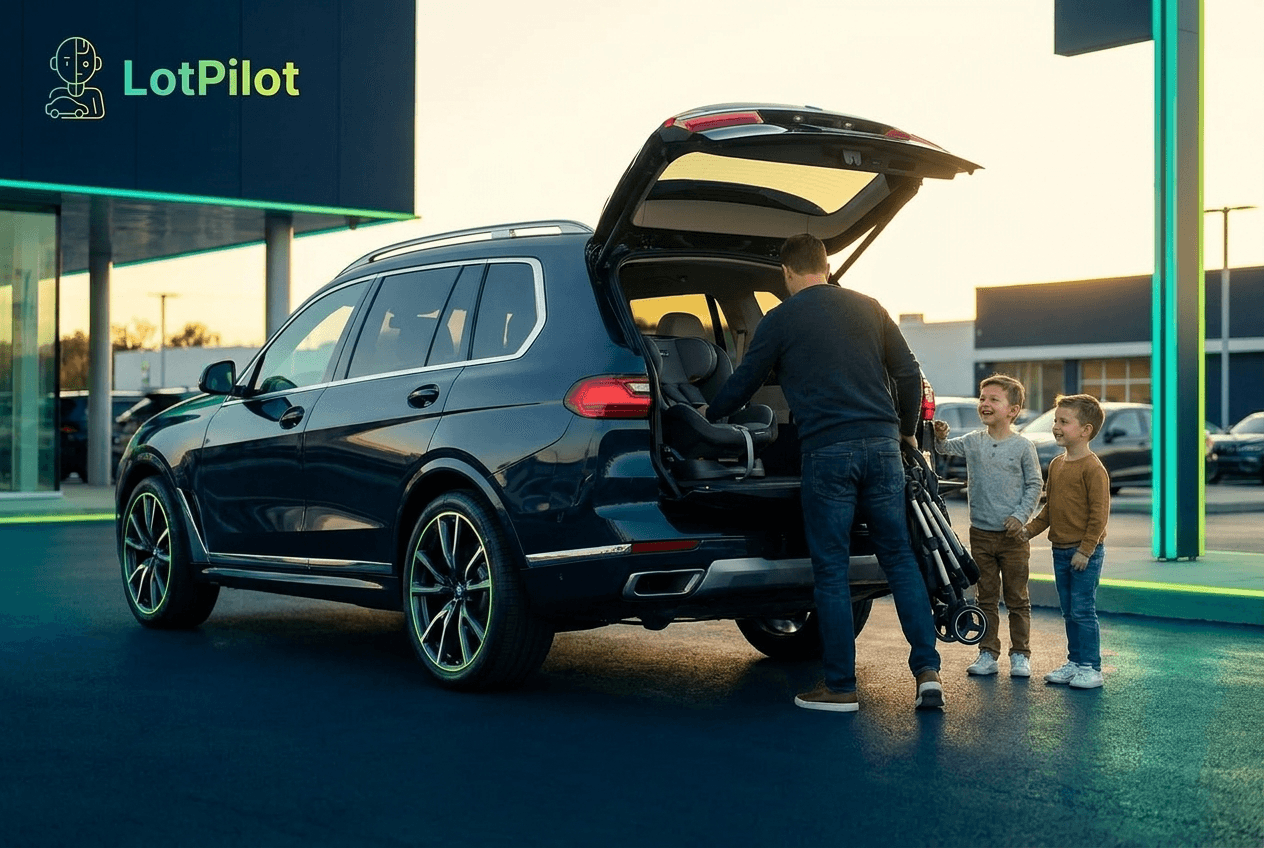
The Family SUV Buying Guide: What Actually Matters When You're Shopping for Three Rows
Shopping for a family SUV is a different exercise than shopping for a car you drive solo. You're not just buying transportation — you're buying the box that holds car seats, cargo, a stroller, three tired kids after a soccer tournament, and your own peace of mind on a rainy highway. The trouble is that "family SUV" now covers everything from a two-row compact to a full-size, eight-seat hauler, and the price gap between them is enormous. Here's how to think about the decision so you buy for how your family actually lives, not for the biggest thing on the lot.
Start with the money — SUVs are where prices are climbing
Buyers keep moving toward SUVs, and prices have followed. According to Kelley Blue Book data from Cox Automotive, the average transaction price for a new vehicle was $49,758 in June 2026. The midsize SUV segment — the sweet spot for most growing families — ran even higher, averaging $50,148 in February 2026, up 3.5% year over year. That's the market average, not a sticker you're forced to accept, but it tells you the family-SUV aisle is one of the pricier corners of the showroom. Decide your out-the-door budget before you fall in love with a third row you may not need.
Match rows to reality, not to "someday"
The most common family-SUV mistake is buying a third row that lives folded flat 360 days a year. A three-row SUV costs more to buy, insure, and fuel, and it's harder to park. If you have two kids and occasional grandparent duty, a two-row compact or midsize SUV is often the smarter buy; you can rent something bigger for the two road trips a year that need it.
If you genuinely need three rows, pay attention to the number nobody mentions in the ad: cargo space behind the third row, when everyone's actually sitting in it. Many popular models shrink to almost nothing back there. The Honda Pilot offers up to 22.4 cubic feet behind the third row on some trims (counting under-floor storage), the Volkswagen Atlas about 20.6, and the Hyundai Palisade roughly 20.2 with the third row slid forward. Those are among the more generous figures in the class — plenty of rivals give you far less. Bring your stroller and a suitcase to the test drive and load them in with all seats up.
Safety: SUVs aren't automatically the safe choice
Parents often assume bigger equals safer, and that's only half true. A vehicle's mass helps protect occupants in multi-vehicle crashes — that's real. But SUVs have a higher center of gravity, and the rollover math shows it. IIHS fatality data for 2024 found that rollovers accounted for about 33% of SUV occupant deaths, compared with roughly 20% for cars. The takeaway isn't "don't buy an SUV" — it's "buy a well-engineered one with strong electronic stability control and top crash-test scores," rather than assuming size alone has you covered.
Use the ratings that are built for this. The IIHS named a large group of three-row midsize and full-size SUVs as 2026 Top Safety Pick or Top Safety Pick+ winners, including the Mazda CX-90 (which earned the higher Top Safety Pick+), Hyundai Palisade, Hyundai Santa Fe, Kia Sorento, Kia EV9, Honda Passport, Nissan Pathfinder, and Subaru Ascent. A Top Safety Pick+ requires good headlights and strong performance in the tougher crash tests across trim levels, so it's a meaningful filter, not marketing.
Bring the car seats to the dealership
A spec sheet can't tell you whether your rear-facing seat fits without shoving the front passenger into the dashboard. Test-fit your actual car seats before you sign. While you're at it, understand the LATCH limits, because they surprise people: NHTSA advises that you stop using the lower anchors once the combined weight of your child plus the car seat reaches 65 pounds, and switch to installing the seat with the vehicle's seat belt at that point. The top tether has no weight limit and should keep being used — it's a genuinely important piece, tied to a large reduction in head-injury risk for forward-facing kids. Also confirm the second row has clearly labeled anchors in the seating positions you'll actually use, and remember that children are safest in the back seat through at least age 12.
Fuel economy is a bigger lever than it looks
A family SUV racks up miles fast — school runs, activities, road trips — so the gap between 25 and 40 mpg adds up to real money over a few years. This is where hybrids have taken over: hybrids reached roughly 49% of the 2026 U.S. market, and it's easy to see why for family use. The Toyota RAV4 Hybrid returns about 40 mpg combined with standard all-wheel drive, and smaller crossovers like the Kia Niro Hybrid reach into the 50s. If your family SUV is going to be the daily workhorse, running the fuel numbers on a hybrid version is worth ten minutes with the EPA figures at FuelEconomy.gov before you decide.
Put it together before you shop
Write down four things: your true out-the-door budget, how many rows you actually use most weeks, the car seats you need to fit, and your realistic annual mileage. Those four answers will steer you toward a shortlist faster than any "best SUV" list can — and they'll keep you from overpaying for capability you'll rarely touch. When you're ready to compare real inventory across dealers, a tool like LotPilot can line up trims, prices, and equipment side by side so the shortlist you built actually matches what's on the lots near you. Buy for the family you have on a normal Tuesday, and the road trips take care of themselves.